


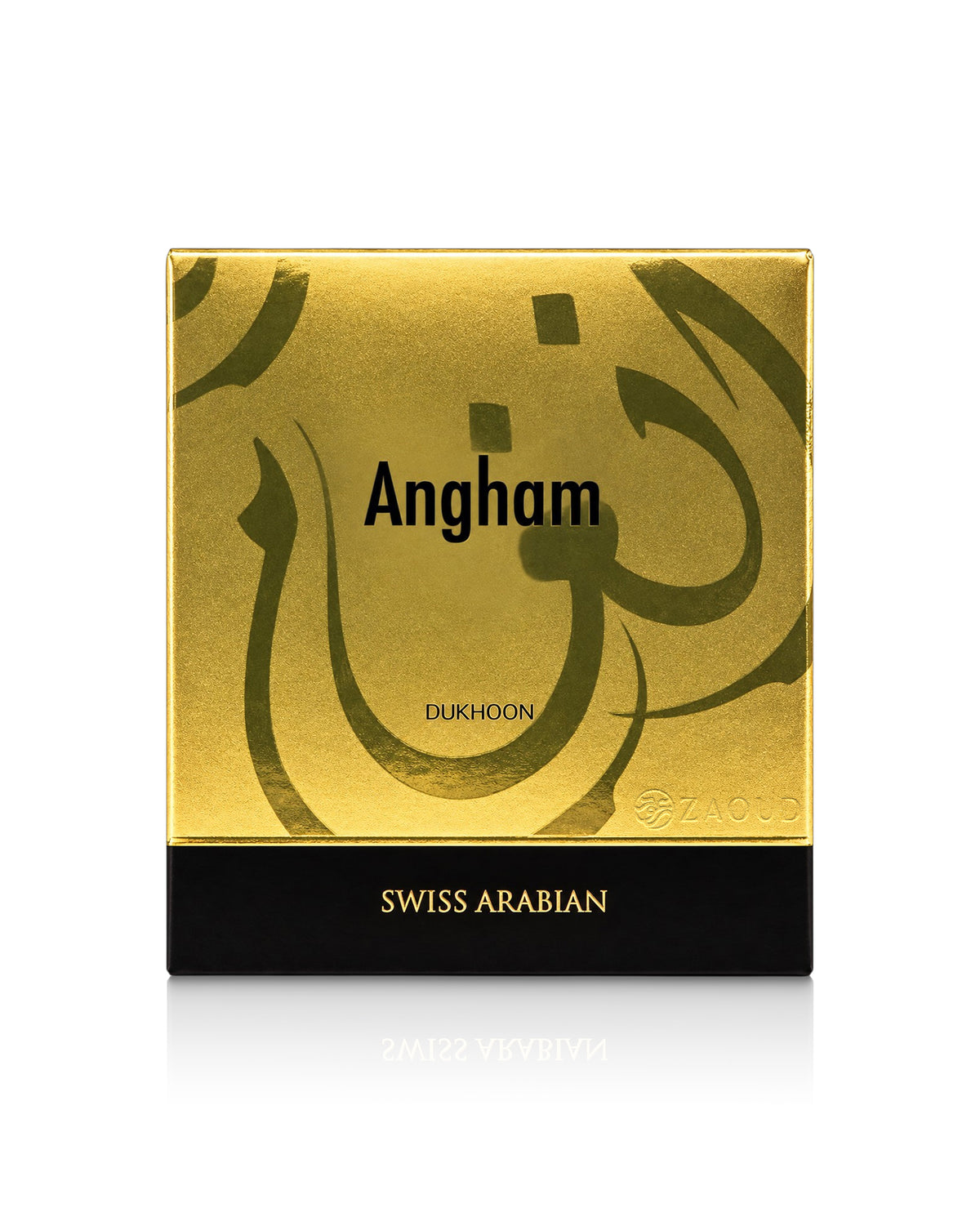


ANGHAM DUKHOON Incense
Swiss Arabian Dukhoon Angham 96g: What This Bakhoor Actually Smells Like
Swiss Arabian Dukhoon Angham is a 96 gram bakhoor built on rose and saffron. Oud, labdanum and patchouli carry the base. Swiss Arabian describe it opening on luxurious rose merging with saffron strands, and the composition supports that reading.
Dukhoon Angham is also unusually elaborate for something you burn. Most bakhoor keeps to wood, oil and resin, while Dukhoon Angham carries a full ten-note perfume structure including aldehydes and heliotrope.
Swiss Arabian Dukhoon Angham: the short version
- What it is: Swiss Arabian Dukhoon Angham comes as a 96 gram bakhoor, burned on charcoal or an electric burner.
- Smells like: Damascene rose and saffron over powdery almond, closing on oud and earthy resin.
- Character: Floral and spicy rather than purely woody. Elegant rather than heavy.
- Notes from: Swiss Arabian’s own listing.
- Best for: Guests, celebrations, and anyone who finds plain oud bakhoor too austere.
Swiss Arabian DUKHOON ANGHAM Frgrance Notes:
- Top Notes: Rose, Saffron, Citrus, Aldehydes.
- Heart Notes: Geranium, Nutmeg, Rose, Coumarin, Heliotrope.
- Base Notes: Oud (Agarwood), Musk, Labdanum, Resins, Patchouli.
Swiss Arabian publishes this list for Dukhoon Angham, and names Damascene rose in its own description of the opening.
What Swiss Arabian Dukhoon Angham smells like
Swiss Arabian Dukhoon Angham leads with rose, and it leads loudly. This is Damascene rose, the jammy and deeply floral kind rather than anything fresh or green. On a hot coal it fills a room within seconds.
Saffron sits directly underneath it, and the pairing is the signature of Gulf perfumery for good reason. Saffron gives the rose a dry, leathery edge that stops it turning sugary. Together they read richer than either would alone.
The citrus and aldehydic notes at the top are the briefest part. They lift the opening and give it a clean sparkle, then disappear almost at once. That is simply what the lightest materials do under heat.
A few minutes in, the middle of Swiss Arabian Dukhoon Angham takes over and the whole thing softens. Geranium adds a green, slightly peppery rosiness and nutmeg brings a dry warm spice. Heliotrope spreads a powdery almond sweetness across everything. This is the stretch where Dukhoon Angham stops being sharp and becomes comfortable.
The base is where it settles for the rest of the evening. Oud gives the dark resinous depth and labdanum adds a sweet leathery warmth beneath it. Patchouli brings damp earth, and musk smooths the edges. The brand describes a gleaming golden drop of oud looming through soft musk, which is florid but not inaccurate.
Taken together it reads floral, spicy and warm rather than smoky and austere. If your reference point for bakhoor is plain oud chips, this is a long way from that.
The saffron is not what most people expect
Ask someone what saffron smells like and they usually describe something golden, warm and faintly sweet. That picture comes from how it colours rice. The perfumery material is nothing like that.
Saffron in a composition reads leathery and dry. There is a rubbery edge to it, a trace of iodine, and something close to hot metal underneath. The molecule responsible is safranal. On its own it is sharp and almost medicinal, and it only turns into a dry animal warmth once diluted into a blend.
Sweetness does arrive, but late. In Swiss Arabian Dukhoon Angham that late warmth bridges the bright rose at the top and the resinous oud underneath. It is the reason the composition holds together instead of splitting into a floral half and a woody half.
Rose and saffron appear together so often in Gulf perfumery for exactly this reason. Rose alone goes sweet and one-dimensional. Saffron roughens it, adds leather, and makes it serious.
Heliotrope and coumarin carry the soft part
The powdery sweetness in the middle is doing more work than its position in the list suggests. Heliotrope smells of almond and vanilla with a faint cherry edge and a dusty, old-fashioned softness. Coumarin sits right beside it, smelling of new-mown hay and tonka bean.
The two are chemically close relatives, so pairing them in Swiss Arabian Dukhoon Angham is deliberate rather than accidental. Together they build a powdered-almond cushion that softens the sharp edges of the saffron and keeps the oud from feeling severe.
Worth knowing that the heliotrope flower yields almost nothing by extraction, so this note is always built rather than harvested. That is not a shortcut. It is simply how the smell has been made since the nineteenth century.
A perfume on wood, not a traditional bakhoor
Traditional bakhoor is simple by design: wood chips or powder, a fragrance oil, a resin, a binder. Four or five elements, built to smell good on a coal.
Dukhoon Angham carries ten listed notes arranged in a proper three-tier structure, including aldehydes, coumarin and heliotrope. That is the architecture of a fine fragrance. Swiss Arabian put it onto a burnable base rather than into a bottle.
You can smell the difference. There is more going on in the first two minutes than most bakhoor manages in twenty. The middle genuinely develops rather than just fading. The trade-off is that the lightest materials burn off fast. That elaborate opening is also the shortest part of the experience.
Burn Swiss Arabian Dukhoon Angham the way you would any bakhoor, on grey charcoal ash or an electric plate. Ventilate the room while it works.
Who Swiss Arabian Dukhoon Angham suits
Anyone who wants a floral bakhoor with real weight behind it. Swiss Arabian Dukhoon Angham is rosier and more elegant than a plain oud. The base stops it from ever feeling light or feminine in a narrow sense.
Occasions suit it. Rose and saffron read as hospitality and celebration across the Gulf. This is a box for guests, for Fridays and for evenings, rather than for scenting a room out of habit.
Skip it if you want pure smoke and resin. The powdery heart and the floral opening are the whole point here. Someone hunting austere woody incense will find them intrusive.
Supporto
Domande frequenti
Tutto quello che c'è da sapere sulla spedizione, l'autenticità e la cura della tua fragranza.
01 Is it Dukhoon Angham or Angham Dukhoon?
02 Is this a rose bakhoor or an oud bakhoor?
Ordini e spedizioni
03 Spedite in tutta Italia?
Sì. Offriamo spedizioni gratuite per tutti gli ordini in Italia superiori a 75 €, solitamente consegnati in 24-48 ore.
04 Come posso tracciare il mio ordine?
Una volta spedito l'ordine, riceverai un link per il tracciamento via email. Potrai anche controllare lo stato dal tuo account.
Autenticità e prodotti
05 I vostri profumi sono autentici?
Sì. Zaoud è un rivenditore di fiducia di profumi arabi e di nicchia autentici al 100%, provenienti da canali ufficiali.
06 Posso avere aiuto nella scelta di una fragranza?
Assolutamente sì. Contattaci in qualsiasi momento per una consulenza gratuita: ti aiuteremo a chiarire ogni dubbio prima dell'acquisto.
Resi e cura
07 Qual è la vostra politica sui resi?
I resi sono accettati su articoli idonei non aperti entro il periodo di tempo indicato nella nostra politica dei resi. Contattare il supporto per avviare un reso.
08 Come dovrei conservare il mio profumo?
Conservare i flaconi in posizione verticale in un luogo fresco e asciutto, lontano dalla luce solare diretta e dal calore per preservare la fragranza.
Hai ancora domande?
Contattaci